// Overview
Research Brief
Game-Based Learning (GBL) is widely recognised as an effective educational approach, yet the optimal conditions for knowledge acquisition within game environments remain poorly understood. This Master's graduation project investigates a specific open question: does embedding an AI-driven interactive element inside a game environment lead to meaningfully better learning outcomes than traditional or non-interactive alternatives?
To study this, I designed and built Scaly Sanctuary — a purpose-built serious game centred on leopard gecko care, a domain chosen because reptile ownership is rapidly increasing while evidence-based educational resources remain scarce, and preventable harm from misinformation is a documented problem. The game features an AI veterinarian NPC (Dr. Erwin Stevens) powered by a Large Language Model, enabling natural language inquiry from the player.
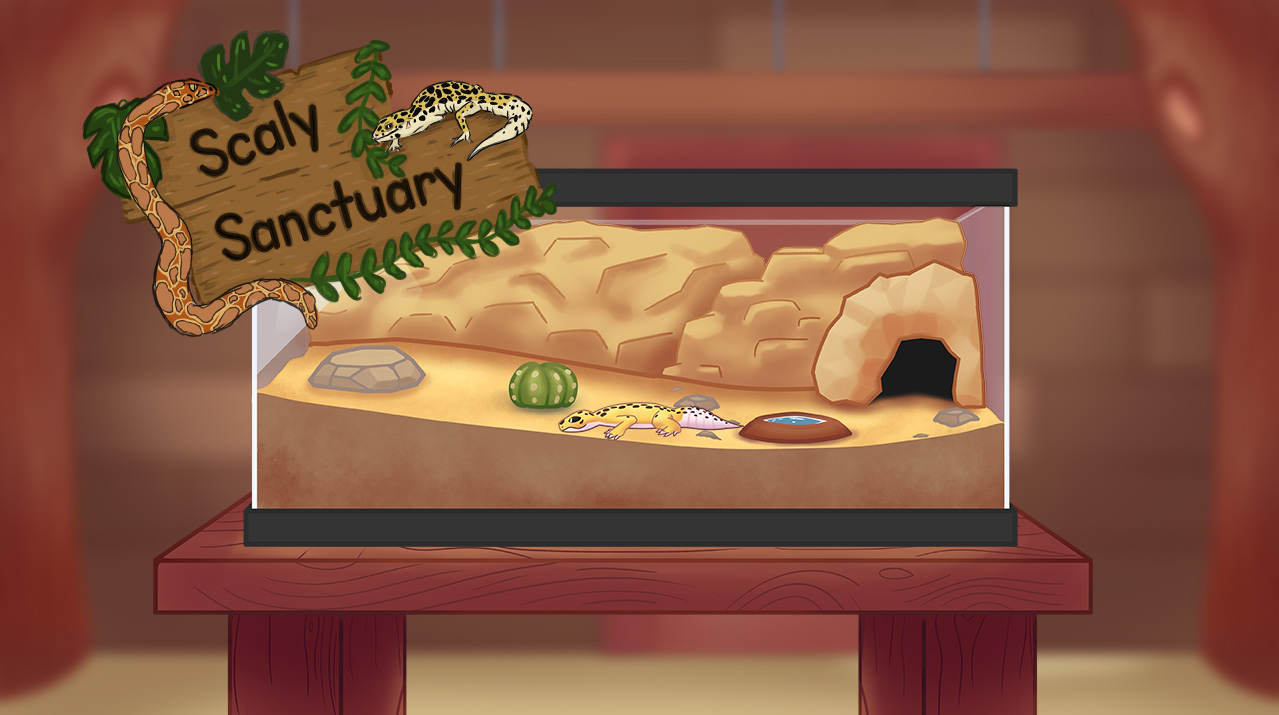
SCALY SANCTUARY — TITLE SCREEN
// Research Context
Why This Matters
📈
Rising Reptile Ownership
Reptile ownership is growing rapidly, but limited evidence-based care resources lead to preventable animal harm — making this domain an ideal applied GBL target.
🎮
Underexplored GBL Domain
Reptile caretaking is a largely unexplored area within game-based learning research — offering a clean, controlled environment for studying knowledge transfer.
🤖
LLMs as Learning Tools
Large Language Models enable dynamic, natural language guidance. Embedding an LLM as an in-game NPC creates a novel form of interactive scaffolding for learners.
❓
The Open Question
GBL is effective — but does the game context matter? And does AI interactivity add measurable learning value beyond a static game or a plain text resource?
// Experimental Design
Four Conditions
The study uses a 2×2 factorial design crossing two variables — Game (game environment vs. plain caresheet) and Interactivity (LLM chatbot vs. no chatbot) — producing four distinct conditions, each with a target sample of 20 participants.
CONTROL · NO GAME · NO AI
📄
Non-Game Control
Information delivered through a plain caresheet outside any game environment. Baseline condition for measuring the raw effect of the game and AI layers.
NO GAME · AI CHATBOT
💬
LLM Chatbot (No Game)
An LLM chatbot presented outside the game environment — isolating the effect of AI interactivity without the game context.
GAME · NO AI
🎮
Game — Non-Interactive
Information delivered through a caresheet embedded inside the game environment — isolating the effect of the game context without AI interactivity.
★ GAME · AI CHATBOT
🦎🤖
Game — LLM Interactive
The full experience: an LLM-powered AI vet NPC embedded inside the game environment. The primary experimental condition — combining both game context and AI-driven interactivity.
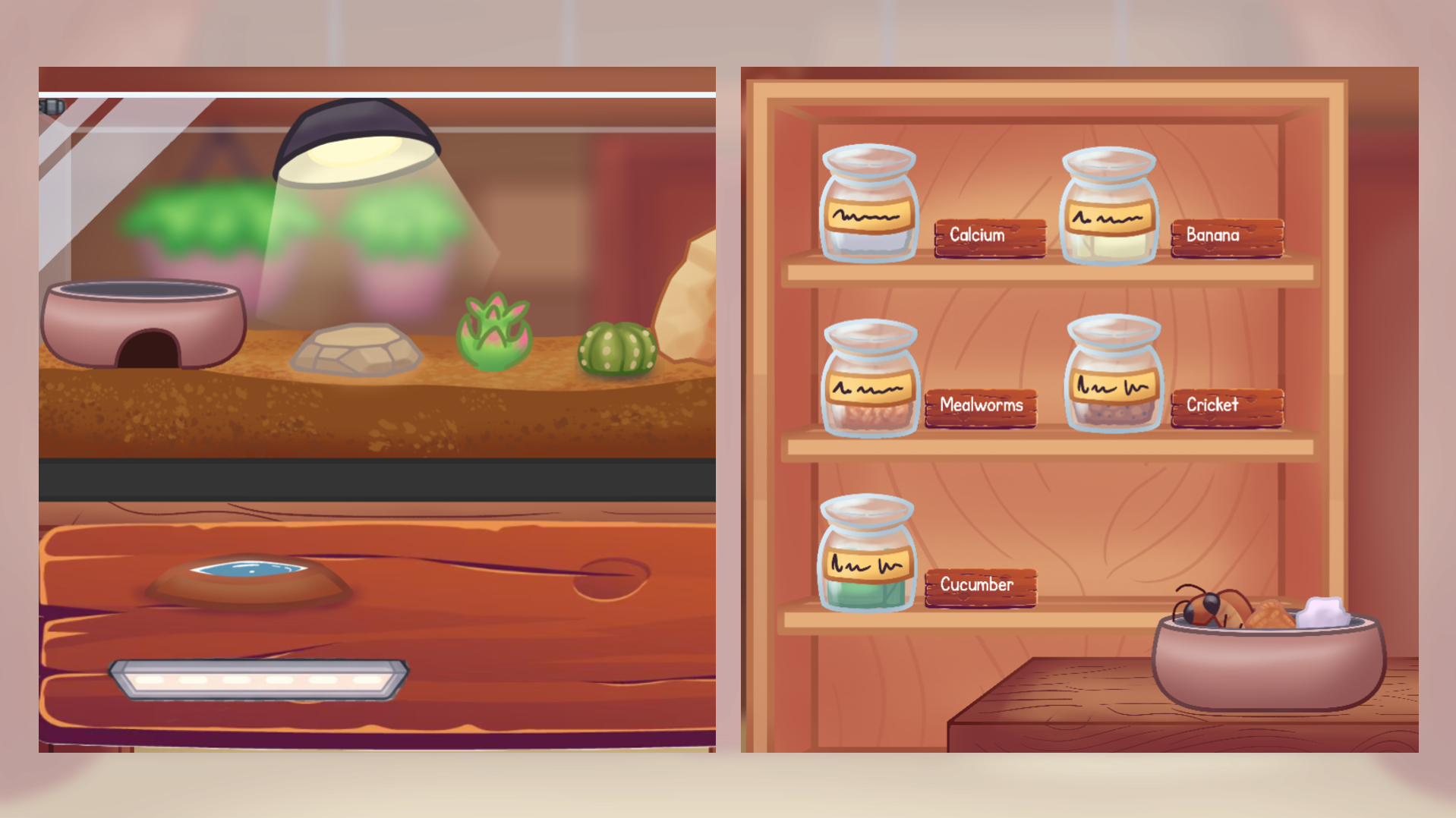
GAMEPLAY — TERRARIUM & FEEDING MODULES
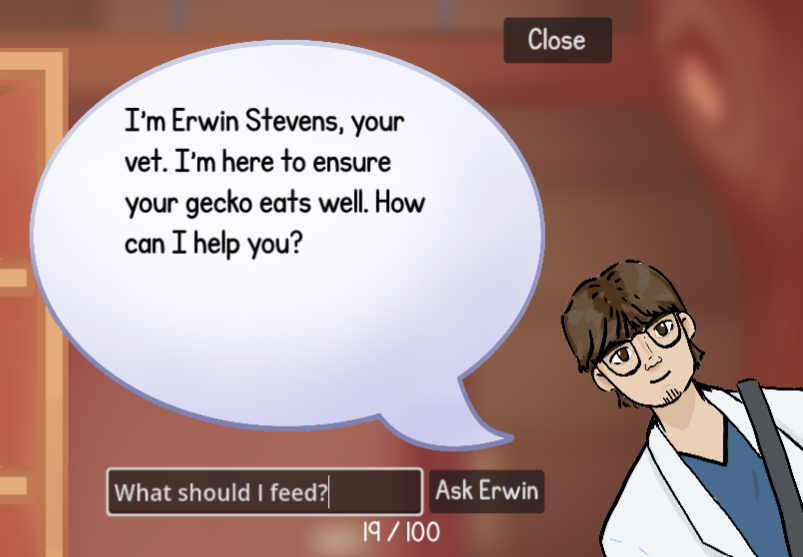
IN-GAME AI VET — DR. ERWIN STEVENS (LLM NPC)
// Game Design
Knowledge Modules
Scaly Sanctuary is structured around two core knowledge modules, each targeting a distinct domain of leopard gecko care. Together they cover the six concepts assessed in the pre- and post-knowledge quizzes.
MODULE_01
Feeding
Players interact with feeding mechanics — selecting appropriate food items (mealworms, crickets, calcium supplementation) and learning the nutritional needs of leopard geckos. Covers 3 of the 6 assessed knowledge concepts.
MODULE_02
Terrarium Building
Players set up and manage a terrarium environment — configuring lighting, hides, substrate, and temperature zones. Covers the remaining 3 assessed knowledge concepts related to habitat requirements.
// AI Integration
The In-Game AI Vet
Central to the Game-LLM-Interactive condition is Dr. Erwin Stevens — an AI veterinarian NPC driven by a Large Language Model. Players can ask Erwin natural language questions during gameplay, receiving dynamic, contextualised responses about gecko care. This replaces static information delivery with an on-demand, conversational learning scaffold embedded directly in the game world.
NPC NAMEDr. Erwin Stevens
POWERED BYLarge Language Model (LLM)
INTERACTION TYPENatural language free-text input
CHARACTER LIMIT100 characters per query
DOMAINLeopard gecko care (feeding + habitat)
PURPOSEOn-demand in-game educational scaffolding
// Methodology
Study Procedure
📝
STEP_01
Pre-Knowledge Quiz
Purpose-built pre-test covering 6 concepts (3 Feeding + 3 Terrarium) using multiple-choice and scenario-based items. Establishes a baseline knowledge score for each participant before treatment.
🎮
STEP_02
Information Exposure
Each participant is assigned to one of the four conditions. Knowledge is delivered through that single condition only — allowing clean between-condition comparison on the post-test.
📊
STEP_03
Post-Knowledge Quiz
Post-test using the same six questions as the pre-test, assessing knowledge retained after treatment. Also includes an engagement measure to evaluate learner satisfaction across conditions.
DESIGN2×2 Factorial (Game × Interactivity)
CONDITIONS4 (Non-Game · LLM Only · Game · Game+LLM)
TARGET SAMPLE20 participants per condition (80 total)
DOMAINLeopard gecko care
MEASURESPre/post knowledge gain · Engagement
INSTITUTIONFontys Hogeschool — Master Applied IT
// Expected Results
Hypotheses
H1
Within-Condition Learning Gains
All four conditions are expected to yield significant pre–post knowledge gains — confirming that each treatment delivers some level of effective learning.
H2
Game vs. Non-Game Advantage
Game-based conditions are expected to outperform the non-game control on the post-test — demonstrating a measurable game-context advantage for knowledge acquisition.
H3
LLM Interactivity Advantage
The Game-LLM-Interactive condition is expected to yield the highest overall knowledge gains — showing that AI-driven interactivity adds measurable value on top of the game environment.
H4
Learner Satisfaction & Engagement
Engagement is expected to be highest in the LLM-Interactive condition, with the game-based conditions consistently scoring higher than the non-game control.
// Discussion
Limitations & Future Work
⚠️
Generalizability
The study is scoped to the leopard gecko care domain — findings may not directly transfer to other educational contexts or game genres. Domain specificity is a deliberate trade-off for experimental control.
⏱️
Long-Term Retention
No assessment of long-term knowledge retention is included in the current design. Future iterations should incorporate delayed post-tests to evaluate durability of learning outcomes.
🔭
Future Work
Planned extensions include retention studies, diverse learner populations, and broadening the domain to other exotic pet care areas — building toward a generalised model of AI-enhanced GBL.
📚
Key References
Plass et al. (2015) — Foundations of GBL · Rondon et al. (2013) — GBL vs. traditional learning retention · Wouters et al. (2017) — Surprising events in serious games and mathematics learning.
← Return to Mission Log

